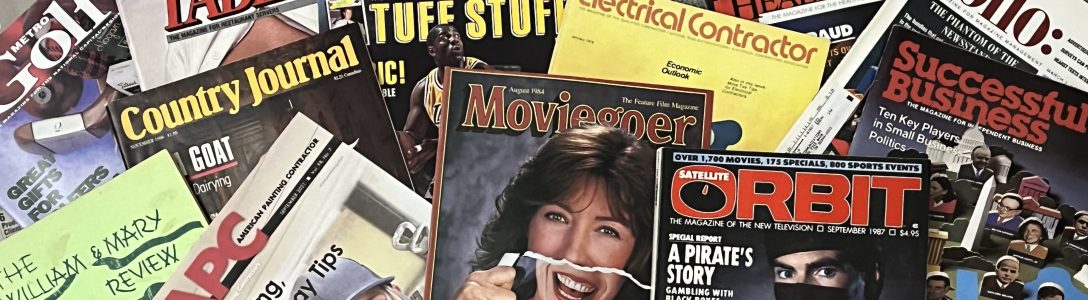
In early 1972, with my graduation from William & Mary looming, one question grew more urgent by the day: How would I support myself, my wife, and our young daughter? An English Lit major, I hoped to make a living as a writer and editor. And I had learned a few things as editor of the campus literary magazine, The William & Mary Review. Still, how was I going to find work in publishing?
My father had one answer: Apply for a federal job. By then, he had put in more than 30 years with the civil service in D.C., most of them at the IRS national office in a senior personnel role. Many of the people who had worked for him were now the heads of personnel at federal agencies all over town. So I just had to say the word and he could arrange the meetings in a heartbeat.
Somehow, I couldn’t picture myself editing a newsletter at the Department of Transportation, or writing booklets at Housing & Urban Development. While I could count on job security and decent pay on Uncle Sugar’s payroll, my ambition was to try my hand in the real publishing world, working for a magazine or a book publisher. But how could I get a foothold at those lofty companies?
My ambition was to try my hand in the real publishing world, working for a magazine or a book publisher.

Enter David Clay Jenkins. Dr. Jenkins had been my freshman advisor in the English Department, and with my senior year winding down, he was now advising me on my honors thesis. And he had a career suggestion: Turns out, a former student of his now had a big job at Houghton-Mifflin, the giant textbook publishing company. And how did he get his start? As a college traveler.
A what? A college traveler, it turned out, goes from campus to campus meeting with professors to pitch the latest textbooks. The goal was to get your Psychology 101 text “adopted” by the professor as required reading. It was a long way from editing Tom Wolfe, but it was a foot in the door, or so argued Dr. Jenkins.
So, in short order, I checked the classifieds in the Washington Post, where I found an ad seeking college travelers. I applied, met with the headhunter, and was soon on my way to New York City to interview with a division of Harper & Row.
I was to meet with Jack Jennings, president of Canfield Press, at Harper & Row headquarters on East 53rd Street. His newly minted division published textbooks for the burgeoning community college market, and Jack needed college travelers to get the word out. He had flown in from Canfield Press headquarters in San Francisco.
If they were out to impress me, they did. This was the big time. Harper & Row’s offices were in the heart of midtown Manhattan, right off Fifth Avenue and a stone’s throw from Rockefeller Center and Scribner’s bookstore. The cab from LaGuardia dropped me at 10 East 53rd and I navigated my way to the office where Jennings was camped out. A trim, sandy-haired Californian, he informed me that I had passed the first test just by finding him. To be successful, a college traveler has to be able to track down professors on sprawling campuses.
The rest of the hiring process flew by in a blur. By the end of 1972, I was on staff, assigned to cover community colleges in a territory that stretched from southern Pennsylvania, through Maryland, to Northern Virginia. My wife and I found a garden apartment in Gaithersburg, Maryland, a suburb of D.C. And the first item on my training agenda was the Canfield Press sales meeting in Tiburon, California, across the bay from San Francisco. My career in publishing was launched!
—To be continued
 finncandenza
Well written, as usual, Frank. Puts the rest of us to shame. Oops, negative vibe. I meant makes the rest of us proud.
Much appreciated, Jim!
Love it. More please…