
“Aw, hell! Let’s just get on a plane and fly up to Nome so you can see the job first-hand!”
On assignment for Electrical Contractor magazine in 1975, I sat across from Charlie Bussell, president of Alaska Bussell Electric Co. of Anchorage. I was interviewing him about a project his company took on in Nome, restoring the electrical systems of two giant dredges operated by Alaska Gold Company. When the price of gold shot up to $195 an ounce in late 1974–a side effect of the OPEC oil embargo–dredging for gold in the sand and gravel deposits outside of Nome made economic sense for the first time since 1962. And Charlie’s company landed the contract to get the gold dredges back into operation.
Part of my job as managing editor was to travel the country, interviewing contractors for a series in the magazine called “Challenging Jobs.” On this trip, I had already flown from Washington, D.C. to Anchorage with stops to interview contractors in Denver and Seattle. Somehow, the prospect of adding a round trip to Nome and an extra day to my trip was less than appealing.
“I really need to get back,” I said, feeling decidedly un-adventurous.
“OK, suit yourself,” said Charlie, clearly disappointed.
I didn’t need to fly 500 miles to the shores of the Bering Sea to feel adventurous. I’d flown up from Seattle on an L-1011, Lockheed’s answer to the Boeing 747. On final approach to the Anchorage airport, with the waters of the Cook Inlet below, turbulence hit and the jumbo jet started sliding sideways. Suddenly, the engines roared, the plane’s nose lifted, and we climbed back into the sky.
“Sorry about that, folks,” said the captain over the PA. “The crosswinds at the end of the runway exceeded the design limits of the L-1011, so we had to abort the landing. We’ll circle for a while and try again when the winds die down.”
The crosswinds at the end of the runway exceeded the design limits of the L-1011.
After one hour in a holding pattern, the captain came back on the intercom: “Good news! The winds have dropped off some, so we’re going to give it another try.” This time, despite a scary amount of bucking and sliding sideways, we touched down safely. The relieved passengers cheered and applauded (including me). Was it a narrow escape? Close enough that a row of fire engines had lined the runway, just in case.
After a night at the Captain Cook Hotel in downtown Anchorage, I made my way to Alaska Bussell Electric’s offices. Charlie welcomed me and led the way into a conference room dominated by a glass-topped table at least four feet across.
“Like it?” he asked. “That’s a slice of the Trans-Alaska Pipeline.” The massive project to build the pipeline had started in 1969. When complete, it would carry crude oil 800 miles from Prudhoe Bay on the North Slope to Valdez, 118 miles east of Anchorage. “There’s a thriving black market for materials and equipment from the pipeline,” Charlie explained. “Welders cut sections like this, draw the map of Alaska on the side and trace the pipeline route down the middle. They turn them into tables and make a bundle.”
Settling in at the pipeline table, I switched on my tape recorder and Charlie began trying to help me understand the scope of the gold-dredge project. He pulled out a photo of Dredge #5, one of two he had to get running again–and fast. Originally built in 1940, it had been abandoned in the hills three miles inland from Nome. Staring at the photo of the dredge in a barren landscape, I had no way to judge the machine’s size. So Charlie recited its vital statistics: From the tip of the bucket line to the end of the conveyor, the dredge measured 535 feet, one long pass short of two football fields. The center structure was six stories high and 72 feet wide. It weighed 3,400 tons “dry” (when not processing gravel and sand). Each of the 135 buckets on the front end could dig up nine cubic feet of gravel. In short, it was huge.
Dredge #5 turned out to be in excellent condition, thanks to the lack of humidity away from the Bering Sea. Charlie’s team was able to repair every motor on board and get the machine up and running for the 1975 mining season. It operated for 117 days that year and recovered 7,791 ounces of gold worth $1.5 million ($7.4 million in today’s dollars). That came close to matching the 9,146 ounces mined in the entire state of Alaska in 1974.
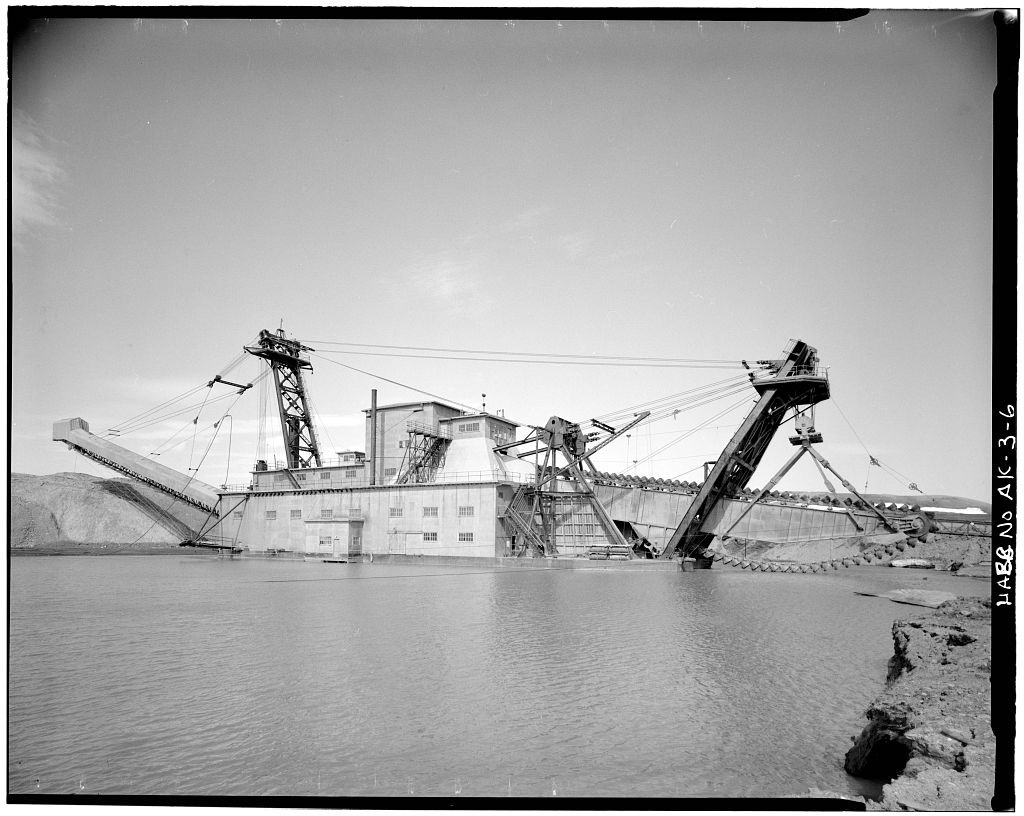
Dredge #6 was a different story. It had been abandoned next to a beach where the salt air and moisture corroded its electrical systems. “We’ve replaced all of the switching equipment, the load centers, the drive equipment, and the pump motors,” Charlie said. “Starting with the high-voltage switch coming on board, it’s all new.” As a result, Dredge #6 didn’t come on line until 1976.
When Charlie opened an office in Nome to oversee the dredge project, he became the only electrical contractor in town. So when the city of Nome decided to install streetlights, Alaska Bussell got the job. As they were digging holes to set the light poles in temperatures as low as 30 below zero, Charlie’s crew got a taste of the Gold Rush days.
“We had a hard time keeping the dirt,” he explained. “People were hauling it away to pan it for gold.” Turns out, Nome was built on sandy soil that had never been mined. One resident extracted an ounce and a half of gold from the post-hole dirt in front of Nome’s Gold Nugget Hotel.
Forty-five years later, do I regret not jumping at the chance to visit that wild place a stone’s throw from the Arctic Circle? You bet I do.
 finncandenza