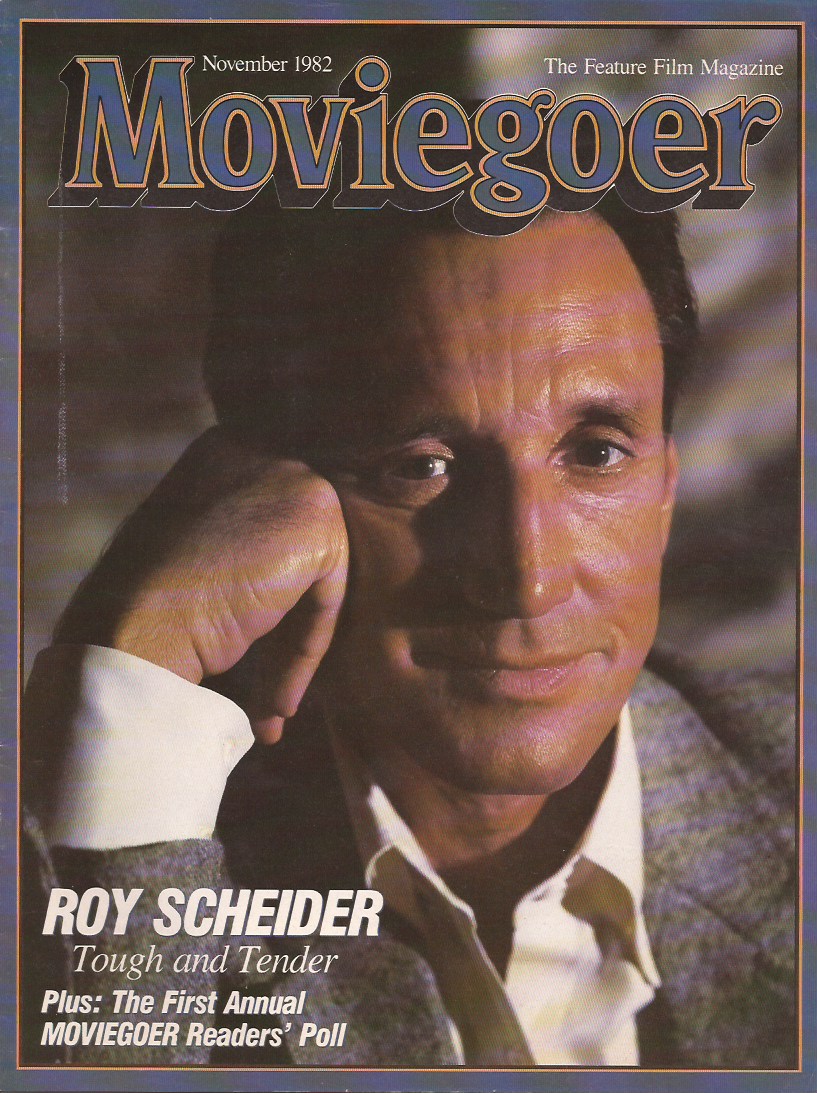
I didn’t go out of my way to piss off Roy Scheider, the star of Jaws, the man who uttered the immortal line, “You’re gonna need a bigger boat.” Who in their right mind would set out to anger the one-time boxer and two-time Academy Award nominee (Best Supporting Actor in 1971 for The French Connection and Best Actor in 1979 for All That Jazz)? But you have to understand. I had no choice.
It was the summer of 1982. I was at the beach with my family, enjoying time away from my job at 13-30 Corp. in Knoxville, Tennessee. It had been a hectic 12 months since I landed the assignment to lead the team producing Moviegoer, a monthly film magazine. But it was about to get more hectic. The phone at the beach house rang. Lisa, one of the Moviegoer editors, was calling. “We have to pull the Roy Scheider cover,” she said.
My first year heading up the Moviegoer staff had been a crash course in the workings of the Hollywood publicity machine. To land established movie stars for your cover, you had to pitch their publicists, the gatekeepers who manage their media exposure. These publicists made you jump through hoops before they would recommend your magazine to their clients.
Hoop #1: How much exposure will my client get? Print media couldn’t–and still can’t–match the millions of “eyeballs” delivered by TV shows like Today; Good Morning, America; Entertainment Tonight; and 60 Minutes. Fortunately, we distributed one million copies of Moviegoer to theaters in the top 100 markets every month. Hoop #1: Check.
Hoop #2: Will your coverage be “friendly” to my client? Contrary to the old saying, there is such a thing as bad press. Few movie stars are willing to sit down for an interview and be peppered with questions about their love life or a recent DUI. At Moviegoer, we assured the publicists, we focused on the work–the art of filmmaking. And the journalists we hired were pros who wrote for leading magazines and newspapers, not gossip sheets. Check.
Hoop #3: Will you make my client look good? A movie star’s face is his/her fortune. Before they will sit for a photo session, they need to know that the person behind the camera will capture them at their best. Moviegoer only worked with the top photographers in New York and L.A., and our photo editor or art director (or both) attended the shoots to make sure we got outstanding portraits. Check.
Hoop #4: Have you featured other stars of my client’s wattage on your cover? Actors want to know that they are in good company when they agree to appear on a TV show or a magazine cover. In the case of Moviegoer, our first eight cover subjects in 1982 were:
- January – Burt Reynolds
- February – Alan Alda
- March – Harrison Ford
- April – Michael Caine
- May – Arnold Schwarzenegger
- June – Rachel Ward
- July – Jon Voight
- August – Sylvester Stallone
The September issue with Mick Jagger on the cover was on its way to theaters and October featuring Susan Sarandon was in production. Check and double check.
Hoop #5: Is the timing right? When an actor signs to star in a movie, they agree to do publicity to promote ticket sales. And with publicity, timing is everything. The studio, the actor, and their publicists all want the TV interviews and the magazine covers to land just before their movie hits theaters. It’s all about making sure the film “opens big.” The phone call about the Scheider cover was triggered by a timing issue.
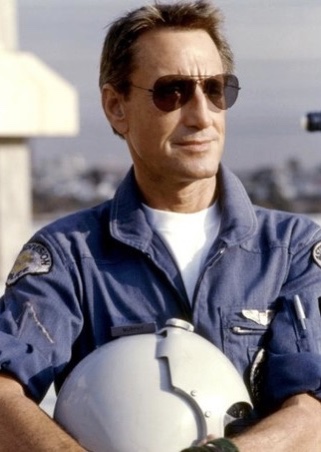
Scheider and his publicist had agreed to do the Moviegoer cover with the understanding that it would appear just before the November release of Blue Thunder, an action flick featuring Scheider as a police helicopter pilot flying a high-tech chopper and battling bad guys in the skies over L.A. Our November issue was “advance dated,” meaning that the magazine would be available in theaters during October. Everything was set until director John Badham (Saturday Night Fever) ran into post-production problems with the special effects, forcing the studio to delay the film’s release until May.
So now, Scheider’s publicist had called to say we had to postpone the cover. The problem was, in late August, production of the November issue was too far along to allow a change. In the pre-digital age, to put one million copies of a magazine into hundreds of theaters nationwide in October, you had to get the materials to the printer two months in advance.
In the end, we had no choice but to tell Scheider’s publicist no. We pointed out that he had another movie coming out in December–Still of the Night–in which he co-starred with Meryl Streep, fresh off her Academy Award-winning performance in Kramer vs. Kramer. Unfortunately, Scheider hated Still of the Night and swore he would do nothing to promote it. (He wasn’t alone. Years later, when Streep was asked if she hated any of her films, she answered, “Still of the Night.”)
Were Scheider and his publicist upset with our answer? Oh, yes–big time. The publicist said, “None of my clients will ever again appear in Moviegoer.” Fortunately, by late 1982, our magazine was in high demand among other publicity firms as a great vehicle for promoting their clients and their movies. We never had any trouble getting A-list actors to do the cover.
Still, I regret that I had to piss off Roy Scheider. If I run into him in the hereafter (he died in 2008), I will offer my hand and say, “Sorry about that Moviegoer cover, Mr. Scheider”–and then duck.
[Thanks to the James McKairnes Archives for the image of the November 1982 cover of Moviegoer.]
 finncandenza
Frank . . . . I never paid much attention to Roy or to Moviegoer, at least not until I read your blog. Not that I care anymore about either now. I just like your writing. I luved this blog. Maybe you were as good a writer way back 40 years ago. Neither you nor I really know. About the only other thing I can say about this article is about your use of double hyphens vs. em dashes. The only reason I even mention that is I’ve struggled with them myself. I looked to the styles at The New Yorker and The New York Times and The Washington Post for guidance. I got confused. So I sought out WordPress’ style sheet, according to Cucumber Marketing — no joke!
{Cucumbermarketing.com/what-the-em-dash-9-tips-for-managing-your-wordpress-website/}
Here’s part of what I found there if you don’t want to read all that they say. However, what they have to say is way more interesting than I ever imagined!
WHEN TO USE HYPHENS Some compound words, such as self-restraint are hyphenated. Numbers between twenty-one and ninety-nine should also be hyphenated when they’re spelled out. But when you’re not sure whether a compound word should have a hyphen or not, check a dictionary or style guide. Hyphenated words tend to become closed compounds (single words with no hyphens) over time. Email instead of e-mail, for example, is increasingly common.
WHEN TO USE EN DASHES En dashes, which are about the width of an upper-case N, are often mistaken for hyphens. But, traditionally, en dashes function as a kind of super hyphen. They’re meant to give you a little extra glue when you have a compound modifier that includes a multi-word element that can’t easily be hyphenated. For example, the phrase Elvis Presley–style dance moves uses an en dash because Elvis-Presley-style dance moves is awkward; “Elvis Presley” isn’t a compound modifier, so hyphenating it looks odd. But, keep in mind, not all readers will notice en dashes or understand what they mean. Sometimes, it’s better to simply reword the phrase.
WHEN TO USE EM DASHES The em dash (about as wide as an uppercase M), is a relatively artistic punctuation mark, compared to the more technical hyphen and en dash. An em dash is most often used to indicate a pause in a sentence. It’s stronger than a comma, but weaker than a period or semicolon.
Whether or not you use spaces around your em dashes (word—word or word — word) is a matter of style. Whichever style you choose, use it consistently throughout your document. Remember, em dashes are not interchangeable with hyphens. Using a single hyphen instead of an em dash can confuse readers and make your writing look unprofessional. If you’re writing text in a program or on a website where the em dash character is completely unavailable, use two hyphens together (–) to signify an em dash.
Wayne, Glad you enjoyed this post. And thanks for the comments about double hyphens. That’s just me being lazy when I should have used em dashes. I will study the Cucumber Marketing guidance. Meanwhile, I’m glad to be in touch after so long.
You are welcome!
This post is a ton of fun. I hadn’t ever heard this story! Xoxo Beck
>